Modeling your portfolios, products, and features
First published on LinkedIn, January 27, 2026
I landed in product management focused on data integrations and some significant back-end, architectural components. It was in that area that I began digging into the “fundamentals” of product management - the outcome focus, the collaboration with customers and business stakeholders, and collaborating with engineering and design to build sustainable solutions. However, the product did not generate revenue and would only be visible on the balance sheet as a drag on the P&L.
My next roles and products were similar - platform or add-on products that could not be an independent business on their own. The first product I was responsible for that started to look like a true P&L was actually a hardware product. While not directly accountable for the financials, I was making decisions based on margins, growth targets, and even revenue mix and impact to valuation. I began thinking more strategically about pricing, contract terms, and other commercial elements of the portfolio. However, this thinking significantly expanded when moving into a role leading an entire product suite. In the Enterprise SaaS space, there is still some translation and nuance, but I’ve adopted a few financial concepts to help with creating stronger clarity around product performance, grounded in how product performance impacts business performance.
Unit Economics
This is one of my favorite concepts, because it requires thinking about meaningful financial metrics in specific operating terms. It’s a calculation of cost or financial benefit per “unit” of production.
This can then be modeled and turned into “what-if” forecasts based on marginal improvements. If the ARR per customer is $1000/yr and the support expense for a customer is $500 per year, every incremental customer contributes $500 in additional gross-margin improvement. You can evaluate and pursue initiatives based on incremental ARR per customer growth or based on incremental cost per customer reduction. You can also outline both fixed costs and variable costs when modeling this out.
In a similar vein, if you’re looking at product benefits, you can begin to transpose some of the product KPIs (like time saved per report) against a financial estimate. If you can confidently point to a quantifiable time savings benefit, you can create an estimated valuation from that benefit.
10 minutes saved per report * 15000 reports per year = 2500 hours of savings (1.25 FTE equivalent hours) – meaningful if that is PER customer savings. Potentially not as meaningful if it’s distributed across 200 customers.
Thinking about and estimating in these terms gives some concrete insights into likely customer valuation and forces you to think more clearly about each of the levers you are looking to influence with an investment.
Challenge: the next investment you evaluate, think about the “levers” that you are influencing and the variables that you either know or don’t know. Work a bit harder to get better information. Try to evaluate the investment in terms of impact to unit economics.
Nuance to Consider: I’ve seen first-hand that a concept like “time savings” is very relative. Time savings relative to your current product? to a competitor’s product? to a pen-and-paper alternative? These variations are important to consider and understand. They also are helpful in positioning your value (are you the hero delivering the savings or just recovering lost ground in an area where your product has been the source of more work). Also, verify that you’re not shuffling work around (causing more pain somewhere else). Seek to understand the second and third order effects of your products.
Product Lifecycle Based Investment Appetite
In the enterprise category, you often have a mix of products that make up the entirety of the “product”. It is not the right approach to treat every one of those products identically, investing in them at the same levels or evaluating success based on the same criteria. However, financial consideration in managing the variety of these products is also important.
I’ve generally kept a mental model of “flagship” products, “add-on” products, and “platform” products, but I’ve seen some more sophisticated approaches that I’ve liked. Understanding the role of each product can also help expand the mental model for “financial success”. Enterprises also often have products in various lifecycle stages, which also influences investment appetite.
In describing lifecycle phases, I generally use the Introduction –> Growth –> Maturity –> Decline lifecycle model. This helps with positioning product investment goals relative to what a product needs. For each product type, each scenario needs to be handled somewhat differently.
Challenge: Read through the matrix below and evaluate where your product sits in terms and category and lifecycle. Does it change any of your thinking about what types of investments make sense? Now think about other products around you. Are you aware enough of the role that the collection of products play in delivering value to customers and to your business? Is there anything you might stop doing based on this understanding?
Flagships
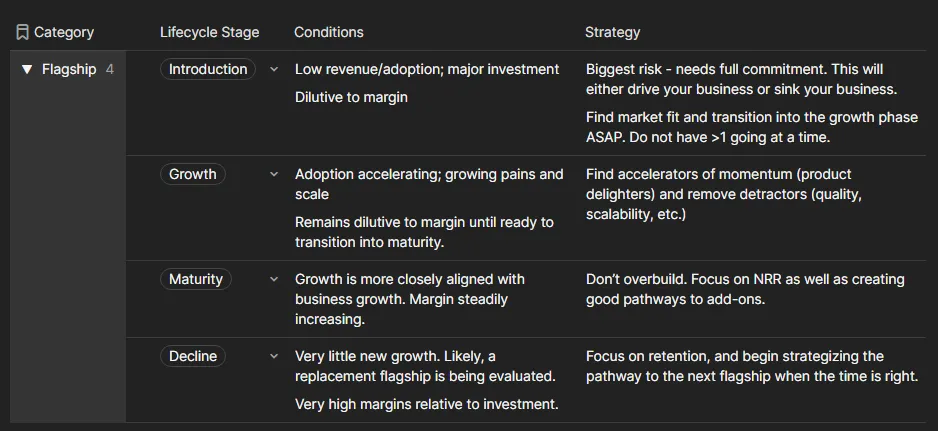
Investment/environment considerations for Flagship products
Flagships get the luxury of looking good on paper most of the time and generally get substantial investment to fund innovation and competitiveness. These products also bear the brunt of the pressure on the commercial front. Without the competitiveness of these products, the add-on products are very unlikely to even get an at-bat. The appetite for investment in these products generally needs to be pretty high, and the corresponding level of commitment should be pretty high before proceeding.
Because flagships are some of the primary drivers of competitiveness in the enterprise space, these products need very intentional investment management. Lifecycle considerations here are weighty and likely represent a very large percentage of current and future revenues. These are major organizational bets - entrance into a new category, a migration path for a large established customer base, or an emerging source of major revenue growth - and should be intentionally and rigorously evaluated.
There is a definite risk here that these teams overbuild, entering into the add-on space or the platform space, adding overhead and diluted focus to the core value of the product. There is also an opposite risk that the core value cannot be effectively realized due to deficiencies in add-on or platform products.
Add-ons
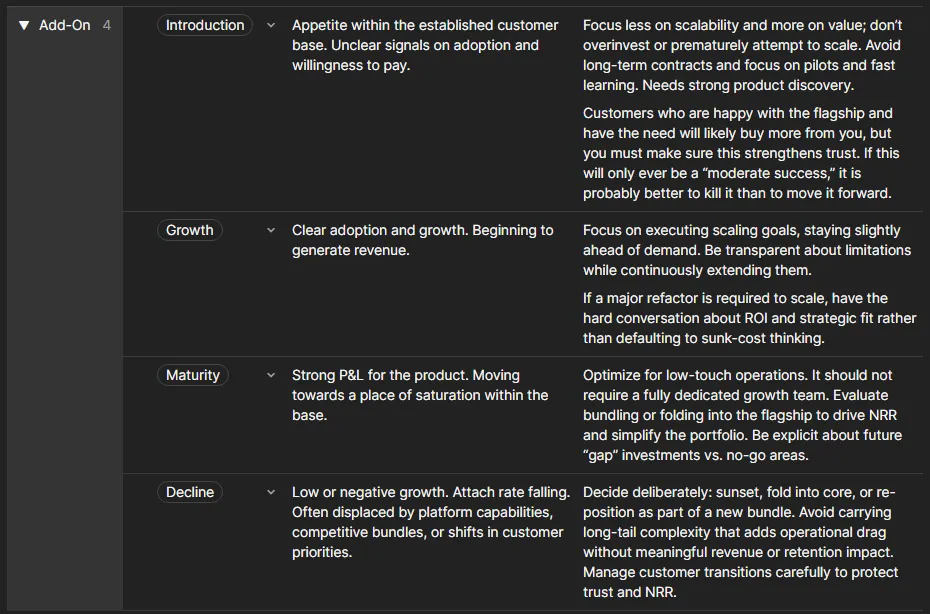
Investment considerations for Add-On products
Add-on’s often represent a nice opportunity for land-and-expand growth, as well as for improving competitiveness of a bundled offering. Add-ons are often operating with fairly high margins, requiring less overall support and avoiding extra complexity. Add-ons that don’t have a strong financial profile should be revisited - if they require excessive work and create support churn, that time may be better spent solidifying flagship products. The trap is mediocrity here. Either the product should be a solid, repeatable growth driver or it shouldn’t exist in the portfolio.
My main advice here - it’s better to have a larger number of small bets in the introduction phase than only one or two large bets. This allows you to pick your winners and then scale them up to maturity. Over time, there are often opportunities to fold add-ons into the core product, solidifying the revenue as part of the offering and maintaining a more manageable level of SKUs.
Platform
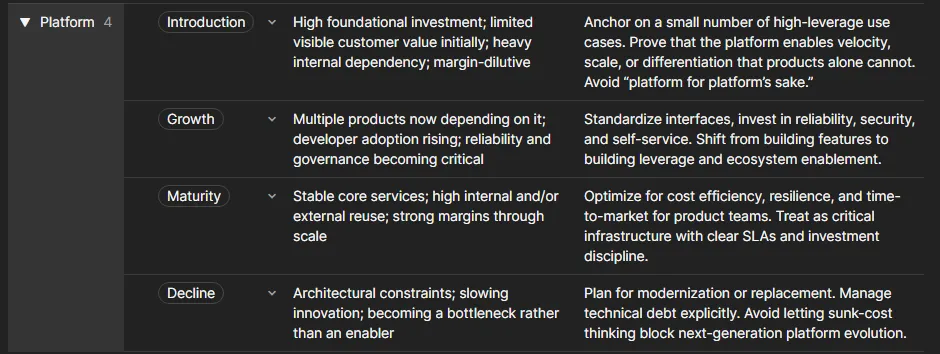
Investment considerations for Platform products
Platform products rarely get to look great on paper but also are often the most sensible on their engineering merits. They are the scaffolding holding many parts of the system up, but they often are not generating revenue. Generally, you can’t operate without it, or it requires a flagship team to be invested in something that is not part of the core value-prop of their product.
The trap here is acting like choice doesn’t exist. Product managers in this area need to be influential intrapreneurs. These teams cannot operate with high levels of entitlement that just because it’s there, others will use it. Instead, investments should be focused on driving tangible value. While platform teams shouldn’t think small, they should work in small meaningful chunks to deliver real, incremental value to other teams.
Wrap-up
The concept of unit economics and lifecycle-based investment appetites are not extremely novel topics, but they also are discussed less than they should be. When going through annual planning activities, we often center around initiatives. When looking at product success, we often center around customer satisfaction, market share, or overall ARR. These are just a couple alternative lenses to look at your product portfolio and make better decisions.
Finally, there is no paint-by-numbers solutions to managing a product or product portfolio. There is no golden KPI that can both be directly impacted and measured, while also delivering outstanding business results. Leaders need vision, creativity and rationality to help steer the ship towards success, whether the ship is a small supporting product or the entire organization.